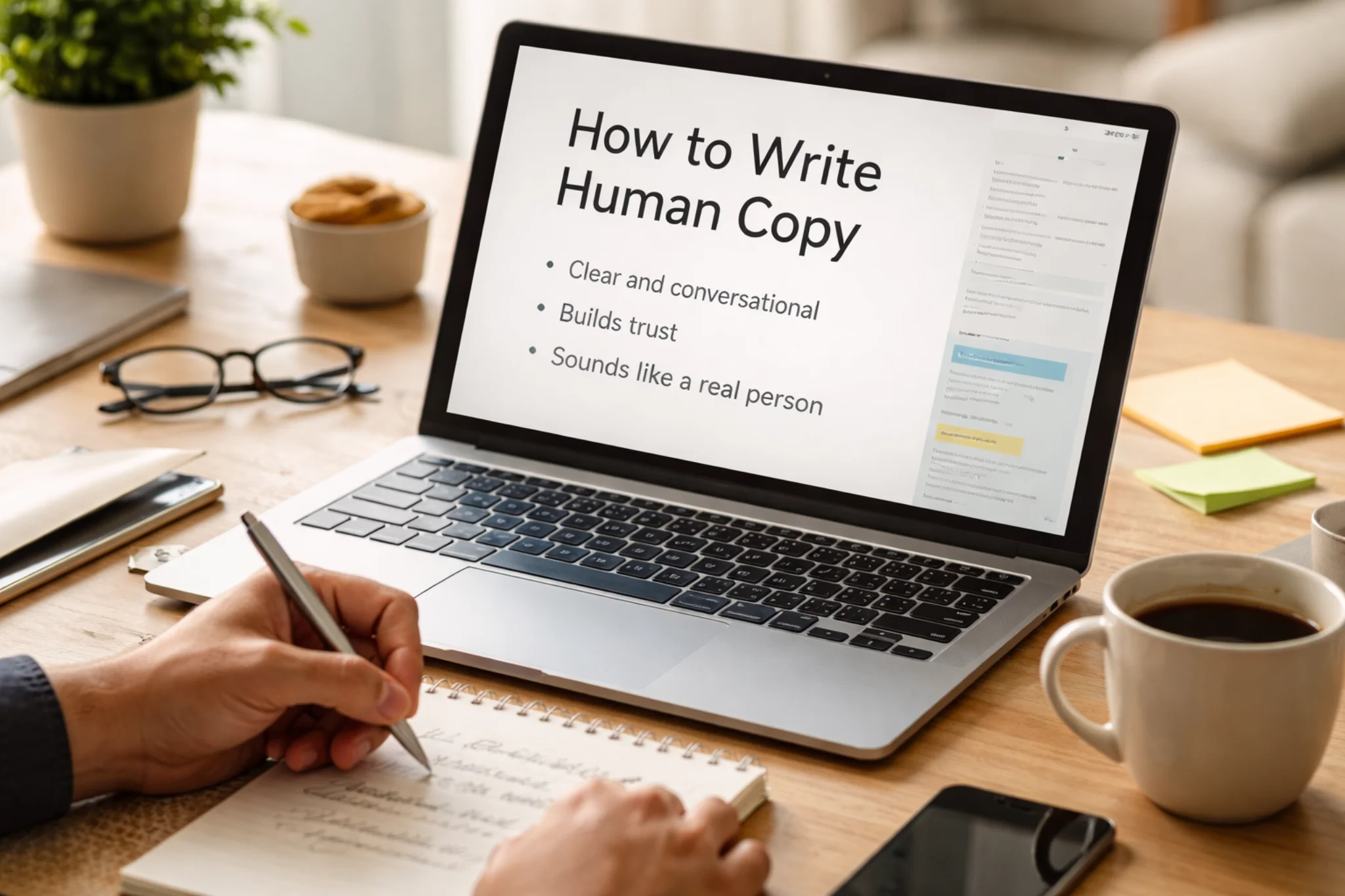
Most website copy is not badly written.
It is just not written for people.
It sounds polished. Professional. Technically correct.
But it feels distant, careful, and oddly hard to connect with.
And when copy does not feel human, people hesitate.
They skim.
They doubt.
They leave.
For small teams and SMEs, this is one of the biggest hidden conversion problems we see. Not because the business lacks expertise, but because the website sounds like it was written for approval, not understanding.
This guide explains what human-centred copy actually is, why it works, and how to write it in a way that builds trust without losing clarity or credibility.
Most robotic copy is created with good intentions.
Teams want to:
The result is copy that is safe, but vague.
Phrases like:
None of this is wrong.
But none of it helps a visitor understand whether you are right for them.
Another common cause is internal language leaking into public copy. Teams write using the words they use in meetings, documents, and decks. Language that makes sense internally but feels abstract externally.
A useful rule of thumb we use is this:
If your copy sounds like it was written for a board slide, it probably will not convert on a website.
Human copy is not casual.
It is not chatty.
It does not mean using jokes, emojis, or slang.
Human copy is clear, specific, and familiar.
Human copy prioritises understanding over originality.
If a sentence can be misread, it will be.
If a headline needs explaining, it is working too hard.
Clarity reduces effort. Reduced effort increases trust.
People trust language they recognise.
That does not mean informal language. It means plain language. Words your customers already use when they describe their problems.
If your audience would never say it out loud, think carefully before writing it on your website.
Many websites are written for a fictional “ideal customer” rather than a real person.
Human copy assumes:
It answers the question the visitor is already thinking, not the one the business wants to promote.
Corporate-sounding copy creates friction in subtle ways.
It increases cognitive load.
It delays understanding.
It makes visitors work harder than they should.
When that happens, confidence drops.
This is why many websites show healthy traffic but disappointing enquiries. The issue is not visibility. It is momentum.
We see this repeatedly when reviewing SME websites. It is one of the core patterns covered in 10 Signs Your Website Is Costing You Leads (And How to Fix Them).
People do not leave because they dislike your brand.
They leave because nothing made them feel certain enough to continue.
Understanding how people read is essential to writing copy that works.
Visitors scan first. They look for:
If those signals are missing, they rarely slow down to read in detail.
Most visitors are not looking to be convinced. They are looking to feel safe making a decision.
Human copy reassures before it sells.
Tone signals intent.
Overly formal copy feels distant.
Overly casual copy feels untrustworthy.
Human copy sits in the middle. Calm. Confident. Clear.
This framework works whether you are writing a homepage, service page, or landing page.
Every page is entered with a question already forming.
Examples:
Write to answer that question first. Not later.
If you had one minute to explain what you do to a potential customer, how would you say it?
Write that down.
Then edit it for clarity, not polish.
If it sounds natural when read aloud, you are close.
This is one of the most effective filters.
If you would not say a sentence in a real conversation, it probably does not belong on your website.
Remove it or rewrite it.
Robotic:
“We deliver innovative digital solutions designed to drive growth.”
Human:
“We help small teams turn their website into a clear, reliable source of leads.”
Robotic:
“Our approach is tailored, strategic, and results-driven.”
Human:
“We focus on clarity first, so your website works harder without becoming more complicated.”
Human copy does not try to impress.
It tries to be understood.
Use this checklist on your key pages.
If you want a faster, structured way to assess this, your Website Clarity Check is designed specifically for this purpose:
https://clarity.peoplefirstdigital.com/
It highlights where clarity is helping or hurting conversion, without needing a full redesign.
Human does not mean unstructured.
Clear copy relies on:
Tone builds trust.
Structure sustains it.
This balance is explored in more depth in The Complete Guide to Website Clarity for Small Teams, where we show how clarity and conversion work together.
Some of the highest-converting websites we see are not the most polished.
They are the most understandable.
They:
Human copy creates momentum. Momentum creates action.
Your website is not a presentation.
It is a conversation, happening silently, at scale.
When copy sounds human, people feel seen.
When people feel seen, they act.
If your website feels stiff, vague, or overly careful, clarity has probably been lost along the way.
Fixing that rarely requires more words.
It requires better ones.
If you would like help reviewing where your copy may be holding you back, let’s talk.
Clarity is not about sounding impressive.
It is about being understood.